

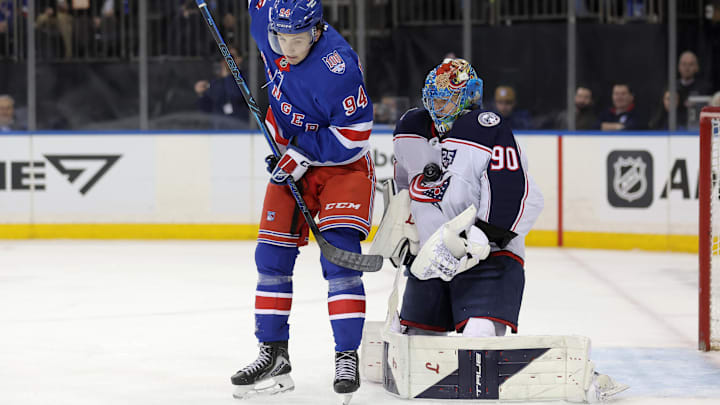
The Columbus Blue Jackets built a 4-0 lead over the New York Rangers last night at Madison Square Garden before blowing it entirely in the third period. The Jackets won the game in overtime, but how they got that 4-0 lead might be a sensitive topic to a Rangers fan this morning.
With the Jackets already ahead 2-0 in the second period, the Rangers got a power-play opportunity. It was a good one, with Blue Jackets captain (and key penalty killer) Boone Jenner in the box. They were hoping to get back into this game.
It looked like they did. They moved the puck quickly around the zone and JT Miller found the back of the net, making it a 2-1 game. Only, hold on a second, the Blue Jackets wanted to take a second look.
For the second game in a row, Rick Bowness decided to use a coach's challenge for goaltender interference. I'll be honest here, at first glance, I was entirely baffled. I thought there was no way they were calling this goal back.
But, as the replay showed over and over, I changed my opinion. Rangers forward Alexis Lafreniere does brush the mask of Elvis Merzlikins as he comes across the crease. The contact happens in the blue paint. It's very subtle, but it does affect the reaction speed of the CBJ goaltender:
The Rangers were not happy after J. T. Miller’s goal was called back for goaltender interference 😬 pic.twitter.com/rJpON8Mx5C
— Sportsnet (@Sportsnet) March 3, 2026
The problem here is, I was certain that there was a worse example of goaltender interference involving the Blue Jackets two nights before, but that goal was allowed to count.
So, when I say I had no confidence in the team winning this one, I mean it. But, I was proven wrong, and much to the chagrin of the Rangers fans in MSG, this goal was called back. And, salt in the wound, the Blue Jackets scored a shorthanded goal just a few seconds later, making it 3-0.
Later in the broadcast, it was mentioned that Lafreniere had contacted the mask of Merzlikins, preventing him from playing his position. Again, it was subtle, but it did happen. The fans in the building would not have gotten that message, however, because the referee didn't offer any explanation over the PA system.
Which brings me to the main point: the NHL's goaltender interference rule needs an overhaul. Not necessarily in the way they call it, but in the way they explain it.
About that Islanders goal...
On Saturday night, the New York Islanders tied the game against the Blue Jackets on a goal that I still don't fully understand. Islanders forward JG Pageau drives Dante Fabbro all the way into Jet Greaves, pushing them into each other and forcing the puck into the net.
PAGEAUUUUUUUUUU pic.twitter.com/7D5MtHWm41
— New York Islanders (@NYIslanders) March 1, 2026
Bowness challenged this play, but lost it. In the heat of the moment, fans were claiming that the first contact happened outside of the blue paint. Sure, no debate there. But, he drives the goaltender through the crease, and he ends up inside of the net. That seems like it should be enough to have the goal come off the board to me.
Later in the broadcast, the only explanation is that the league determined there was no goaltender interference on this play. That's it. Nothing about the contact happening outside of the crease, or being initiated by the Blue Jackets, or any other information.
We asked former NHL referee Dave Jackson for his opinion, and he graciously replied to us on X:
I'm going to assume it was considered incidental contact as opposed to intentional contact and it occurred in the white paint. If goalie had been fully in the blue paint then it would have been a different story
— Dave Jackson (@ESPNRefNHL) March 1, 2026
Fair enough. But, here's the thing: why wasn't this play fully explained by the league? If the contact was deemed incidental, why didn't they say that? Why didn't they mention that the reason for the failed challenge was that the first contact happened in the white paint?
Also, that word "incidental" drives me crazy. Most of these are incidental contact with the goaltender. It's pretty rare for a player in this day and age to intentionally run into a goaltender. So, if that's part of the reason given for a goal counting, shouldn't they all count?
That is the main problem with this rule. The league has no "black and white" way of calling these. It starts with where the contact takes place (inside or outside of the crease), but from there, it's just a judgment call. It's managed entirely on a case-by-case basis, and often, they give you no explanation for why a play was called in any specific way.
To the casual fan, this is very confusing, as was evident in both arenas when these calls were made. They need to either overhaul this rule, or find a better way to explain it. Even as a hockey fan for more than 35 years, this rule has me scratching my head from time to time. I got both of these wrong at first glance.
It legitimately feels like a roll of the dice, any time there is a challenge made. At least we came out on the right end of it last night.
 Add us as a preferred source on Google