

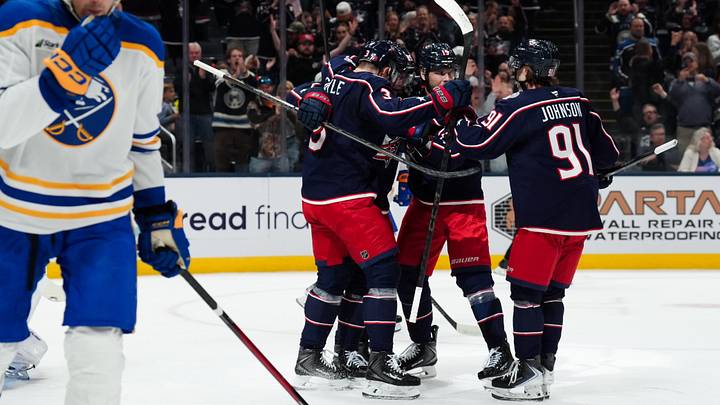
We're 8 games into the 2026-27 season, and the Blue Jackets have won just one game in regulation. That win was on opening night, when they beat the Buffalo Sabres by a 6-3 final score. Coincidentally, that's also the last time this team converted on the power-play.
Yes, that's a fact. In the last 7 games, the Blue Jackets have gone 0 for 20 with the man advantage. They sit dead last in the NHL with a paltry 8.7% conversion rate, with the Sabres (9.1%) being the only other team in the league under 10%. Of further note: 20 teams are at or above 20%.
That's how stark things are when the Jackets get an extra man advantage. You don't have to dig too deep to see that special teams are one of the biggest areas of improvement this team needs to get its season on track.
Of course, special teams includes their penalty kill, which has just a 70% success rate (27th in the NHL). But, that's an article for another time. Today, we're talking about the power-play, which should be a huge point of emphasis for a team that does not have a lot of offensive weapons.
Lets look at both of the power-play goals they actually managed to score in that Buffalo game. This should give us an idea of what works.
Simple but effective.
The first goal we'll break down was scored by Matthew Knies, his first as a Blue Jacket. This highlight begins with what I believe has been one of the biggest issues with this team's power-play for years: puck retrieval. Too often, they are one and done with the man advantage.
But here, Adam Fantilli knocks it out of mid-air and throws an awful pass to Zach Werenski (remember this later). Zach makes a good play at the line and keeps the puck alive, but what really makes this goal is what happens afterwards.
The puck goes low, then back out to Werenski, who looks off the high penalty killer for Buffalo. As their box opens up, he sends a pass back to the open man down low, which completely breaks down their coverage. Knies reads this, backs out to the top of the slot where there is open space, and blasts home a one-timer.
If you think this play looks easy, you're not the only one. But it looks easy because the Jackets didn't try to force too much, and nobody panicked with the puck (outside of Fantilli's ugly first pass). They simply took what Buffalo gave them, broke down their coverage with a pass through the box, and set up a high danger scoring chance. Then, the skill of a high end shooter takes over.
Their second power-play goal of the game, is a prime example of what I think they should not be doing on the man advantage. Somehow, they Forrest Gump their way into scoring a goal despite it.
I'm not sure I could come up with a better video to break down what their power-play issues actually are. On this play, they continuously rim the puck around the boards into pressure, until they finally find the open man (Valeri Nichushkin). Fortunately, he doesn't panic, and actually controls it for a moment.
He makes a nice play here, finding the high bumper (Sean Monahan) for a deflection goal. But, look at how easy it was for Buffalo to defend this sequence leading up to the goal. They simply used a large box and kept everything outside of it. If either of the strong side defenders had taken Monahan's stick on this play, it's an easy clear.
But they made a mistake inside of the box, which was the reason the puck went in. They would want this one back, as opposed to tipping their cap and saying "hey, that was a nice play the other team made". In short: I'm sure this goal was a point of emphasis in their practices that week.
Can't rely on mistakes.
Too often, that second play is exactly what we see from the Blue Jackets. They're content playing on the perimeter with the man advantage, throwing passes around the outside of the opponent's defensive box, and hoping a lane opens up to send a cross-ice pass.
Or worse, they simply try to force one of those passes through, as Fantilli did on the first example above. While he got away with it, the result is usually the puck going 200' the other way. The only way this team seems to score on the power-play, is if their opponents make a mistake. That's not something you can always count on, especially not in the modern NHL.
The formula for success on the man advantage is pretty simple. Break down their box (or diamond) by passing through it. Preferably, with a good pass. Then, find the open space and don't hesitate to fire the puck into the net. Or, fire a shot on goal, create chaos, and...wait for it...retrieve it. Greasy goals count too, boys!
That's all the opposition does, which is why it seems like on any given night, they score on the power-play against the Blue Jackets. Regardless who is on the ice, this is the NHL. With the skill in this league, playing with an extra man should net you a goal every three or four tries. There really isn't much to it. Lets hope this team can figure it out soon.
 Add us as a preferred source on Google