

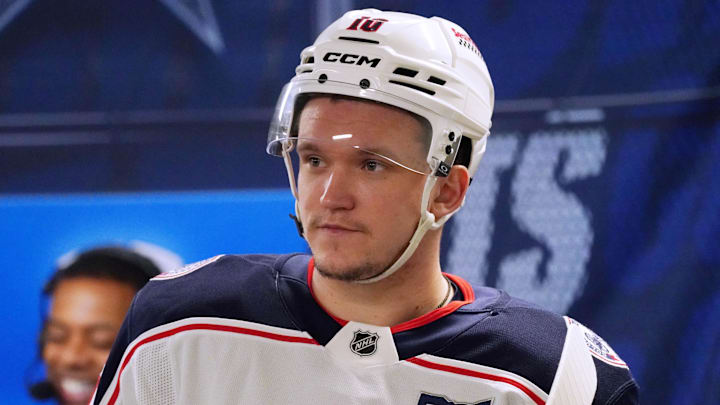
There were many question marks entering the 2025-26 season for the Columbus Blue Jackets. One of the few we thought we had answered was left winger Dmitri Voronkov.
The Jackets are no stranger to scoring by committee, and throughout their history have largely lacked an elite presence on their top line outside of names like Rick Nash, Artemi Panarin, and of course, Johnny Gaudreau. Voronkov was the next top-line winger to throw his hat into the ring, showing intriguing improvement in Columbus from his first season to his second leading into 2025.
The 6'5" 234 lb power forward capped off his 2024-25 season with 23 goals and 47 points in 73 games, finding chemistry with players like Adam Fantilli and Kirill Marchenko as a top six forward. The 25-year-old winger then inked a two-year extension paying him just over $4 million against the cap, and fans were excited to see how high Voronkov's ceiling really was.
Early returns on the extension were excellent. Voronkov battled his way to 10 points in the first 10 games of the season and it looked like the Jackets might have found a diamond in the rough. A former 4th round pick with the size and strength to create plays on and off the puck, including solid power play production.
Players of that architype who can score like Voronkov was at the start of the season are rare. Even Montreal's Juraj Slakovsky, an elite talent of similar build, was slower to the 10 point mark. Unfortunately for Voronkov, the season is far more than 10 games long.
While I didn't expect him to necessarily keep a point a game pace all season, I could not have predicted the gradual drop in production to come in the dog days of the season through January and the Olympic break. It all culminated in a brutal stretch beginning in January 15th that lasted until the end of the season where he would tally just 2 points in his final 17 games. His production had flatlined.
What went wrong?
Some have speculated this could be a result of new head coach Rick Bowness and his system, as he was hired on January 12th. Voronkov began slipping down the lineup, often being used as a 4th line grinder during this stretch, before becoming a consistent healthy scratch in March.
Voronkov would return for one final game against San Jose, where he suffered a hand injury that sidelined him the rest of the season. While there is merit to the Bowness connection, Voronkov's poor play unfortunately was masked by the incredibly positive results the new coach was getting from the rest of the lineup. Until the late season collapse, that is.
Combine that with the aggressive midseason addition of wingers Mason Marchment and Conor Garland via trade, and all of a sudden top six winger slots on the roster needed to be earned more than ever.
Marchment in particular proved himself as an impact player for the Jackets almost immediately, and seized the top line left wing role Voronkov typically occupied before the trade. A spot he essentially retained for the rest of the season.
He would finish the season with 32 points in just 63 games. A noticeable step back from his sophomore season-29 of which came before the coaching change.
How can he rebound?
Outside of recovering from his allegedly minor injury, Voronkov should have no shortage of motivation going into next season. Not only does he need to prove to Bowness, who signed an extension earlier this month, that he can find a way to be a useful scoring winger in the new system, but next year, but the 2026-27 is the final year of his current contract. If the RFA to be can't rise above a 4th line role next season, he would be burning money on his next contract.
Considering the position he is now in, and seeing as how he has now seen what Bowness' system and coaching style looks like, Voronkov needs to find new ways to be useful. There are still a lot of blank spaces in next years lineup, especially with Boone Jenner, Charlie Coyle, and Mason Marchment all still uncertain to return or test the free agent market.
Voronkov needs to find a way to add something to his game that will make him irreplaceable. Some players have the ability to adapt their game to make themselves as useful as possible given any situation. If he can identify a team need and take the offseason to hone his game around it, there is a path to showing Bowness why he is a lot more that a 4th line forward, or replacement level player.
 Add us as a preferred source on Google