

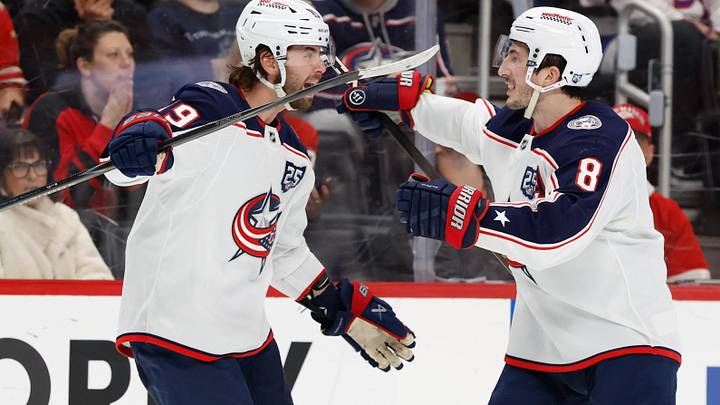
In our preview series for the 2025–26 campaign, I wrote that Adam Fantilli was the centerman Blue Jackets fans had waited twenty‑five years for: the franchise’s future in both the short and long term. I still stand by that, even after a season where “Mo” rode his share of highs and lows.
Fantilli himself has been open about wanting more, as he told BlueJackets.com towards the beginning of the year.
"“I want to be on the scoresheet, I want to help us win games. You can’t win without scoring. I want to contribute there,”"Adam Fantilli
But for all that intent, Fantilli ran into the kind of finishing drought no elite shooter wants to experience.
According to MoneyPuck, when adjusting for his expected finishing ability, Fantilli was expected to score 21.8 even‑strength goals, the sixth‑highest mark in the NHL. He finished with just 14. On the 5 on 4 power play, he produced only 2 goals despite an expected 6.2.
Shooting Talent Adjusted Expected Goals, the metric used here, estimates how many goals a player should score based on shot quality and a history of outperforming xG. By that measure, Fantilli consistently generated the right looks. The puck simply didn’t cooperate for the young forward.
Bad bounces, hot goalies, and plain old variance all played a role. Across all situations, even strength, power play, penalty kill, Fantilli finished fourth‑worst in the league with 10.4 goals below expectation.
Yet the season wasn’t defined by frustration alone. Fantilli clearly took steps defensively as he continued to round out his game. His primary line combinations, Kirill Marchenko on the right, with Mason Marchment or Dmitri Voronkov on the left, all posted positive xGF/xGA per‑60 ratios and generally controlled play with him on the ice. There’s still room to grow, but Mo is learning how to leverage his above‑average size and well‑above‑average skating in all three zones.
And even with the finishing drought, Fantilli still produced. He posted a 24‑35‑59 line in 82 games, adding five points to last year’s total and playing a full season for the second straight year. He logged a career‑high 18:54 per night, recorded 38 penalty minutes, and finished at -13 on a team that struggled defensively for long stretches.
Now, for the first time in his young career, Fantilli enters the offseason as a restricted free agent. As of this writing, he remains unsigned for 2026–27 and is technically eligible for an offer sheet. But the odds of Columbus letting their likely franchise forward walk are effectively zero, despite what some opposing fan sites have bizarrely speculated this summer.
The organization knows exactly what they have: a 21‑year‑old center who drove play, battled through brutal shooting luck, and still produced like a top‑six forward.
Everything in his statistical profile, usage, underlying numbers, defensive growth, and the sheer scale of his finishing regression, points toward a player on the verge of a breakout, and I feel he met the eye test as well. The foundation is there, the process is there. The next step is simply the puck going in.
And when it does, Fantilli’s rise could be rapid.
 Add us as a preferred source on Google